
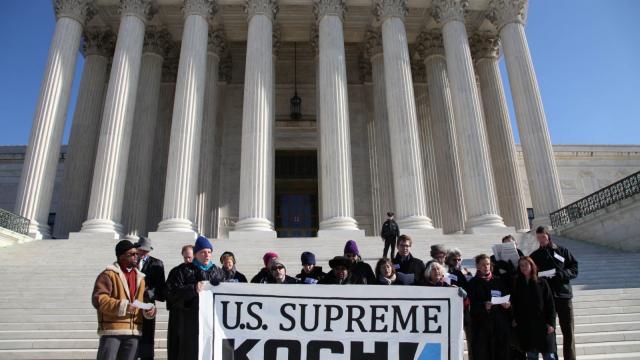
Constitutional amendments are often proposed but rarely advanced to the stage of serious debate. What moves any meaningful amendment from mere paperwork to serious consideration is the popular will of the great mass of Americans. And the popular will of the great mass of Americans have been abundantly clear since the United States Supreme Court struck down barriers to corporate control of democracy with its 2010 Citizens United v. Federal Election Commission ruling.
Sixteen American states and roughly 600 communities have formally told Congress that the Constitution must be amended to make it clear that corporations are not people, money is not speech and citizens and their elected representatives have a right to organize elections that are defined by votes rather than dollars.
Once dismissed even by many reformers as an appropriate yet impossible initiative, the movement for a “Money Out/Voters In” amendment to the Constitution has grown so strong—and been proven to be so necessary—that it has now achieved what most organizers of amendment movements only imagine.
Last Thursday, the U.S. Senate Judiciary Committee voted 10-8 to endorse an amendment that would undo the damage done to democracy by a series of High Court decisions—and to restore reasonable limits on financial contributions and expenditures intended to influence elections.
Judiciary Committee chair Patrick Leahy, a former prosecutor and the senior member of the Senate, framed the vote with a declaration that “I have served in the Senate for nearly 40 years and as Chairman of the Judiciary Committee for nearly ten. I have always believed that amending our Constitution must be subject to the highest measure of scrutiny. It is something that should only be done as a last resort. But when the voices of hardworking Americans continue to be drowned out by the moneyed few, and when legislative efforts to right this wrong are repeatedly filibustered by Republicans, more serious action must be taken.”
Leahy’s position was echoed by committee Democrats who joined him in backing an amendment that declares:
SECTION 1: To advance democratic self-government and political equality, and to protect the integrity of government and the electoral process, Congress and the States may regulate and set reasonable limits on the raising and spending of money by candidates and others to influence elections.
SECTION 2. Congress and the States shall have power to implement and enforce this article by appropriate legislation, and may distinguish between natural persons and corporations or other artificial entities created by law, including by prohibiting such entities from spending money to influence elections.
SECTION 3. Nothing in this article shall be construed to grant Congress or the States the power to abridge the freedom of the press.
That’s more cautious language than many activists would like to see. And it may be that, as the amendment movement grows in strength, and as the congressional debate evolves, a final amendment will feature more specific language regarding all the issues that arise when the courts and Congress extend special rights to corporations.
But no one should doubt the significance of the fact that, in four short years, a grassroots movement has changed the calculus of the money-in-politics debate. With little money and almost no major media coverage, the movement started by groups such as Move to Amend and Free Speech for People, and advanced by People for the American Way, Common Cause and Public Citizen has staked out bold positions and made overly cautious Democratic officials and even a few Republicans move toward them.
“This vote is an important step forward for the movement to take back our democracy from billionaires and corporations,” declared Marge Baker, the executive vice president of People for the American Way, which was part of a broad coalition of groups that delivered petitions signed by two million Americans asking the committee to back a Twenty-Eighth Amendment proposal based on an approach initially advanced by Senator Tom Udall, D-New Mexico.
“In the wake of cases like Citizens United and McCutcheon, the voices of everyday Americans are being overpowered by the money of special interests,” said Baker. “That’s not how democracy is supposed to work. People understand that. Americans have made it clear that all of our voices should be heard. We look forward to a full Senate vote on this important piece of legislation.”
With Judiciary Committee backing and forty-five cosponsors, the Udall amendment as it currently stands has traction in the Senate. There is a dawning recognition that, as Udall says, “the Supreme Court has left us one option for real reform. We must pass an amendment that will restore integrity to our elections, so that a billionaire in one state cannot have more influence than working families in the other forty-nine. That is not the equality envisioned by our founders, and is in direct contradiction to the kind of democracy they intended to create.”
Public Citizen president Robert Weissman echoed that sentiment in a statement Thursday.
“The amendment is crucial to strengthening and restoring the First Amendment, which has been weakened and distorted by a series of U.S. Supreme Court rulings,” explained Weissman.
“Specifically, the amendment would overturn Citizens United v. Federal Election Commission (FEC) and its misguided holding that corporations have the same First Amendment rights as real, live, breathing human beings to influence election outcomes. It will overturn McCutcheon v. FEC, with its holding that the only justification for limits on campaign donations is to prevent criminal bribery. And it will overturn Buckley v. Valeo—the case holding that ‘money equals speech’ and imposing Supreme Court-made constitutional obstacles to imposing limits on what can be spent on elections.”
But that does not mean that the amendment will move easily through Congress. Senate Republican leaders, led by Minority Leader Mitch McConnell, R-Kentucky, have grown increasingly militant in their opposition to efforts to reduce the overwhelming political influence of corporations and billionaire donors such as the Koch brothers. During Thursday’s Judiciary Committee session, Iowa Senator Chuck Grassley and his fellow Republicans trotted out all the talking points that have been developed as part of a cynical campaign to prevent limits of election spending focusing especially on the fantasy that corporations and wealthy Americans have a right to shout down everyone else.
Because sixty-seven votes are required to secure Senate approval of an amendment, majority support—even if it is bipartisan—will not be sufficient. So the organizing work that got the proposal this far will have to continue. That work is likely to face growing opposition from powerful interests. “We’ve now seen the U.S. Chamber of Commerce and the Koch Brothers take notice of the overwhelming public demand for far-reaching action to restore our democracy. In the coming weeks, we’ll see those defenders and advocates of the 21st Century Gilded Age leverage their power and money to oppose a constitutional amendment that threatens their grip on American politics,” argues Weissman.
But, he adds, “The tide of history is against them, however. The day is not long away when Americans will celebrate the 28th Amendment and the return of control over our elections and our country to We the People.”
Originally published by The Nation
3 WAYS TO SHOW YOUR SUPPORT



- Log in to post comments


