

Americans are sick of politics. Only 13 percent approve of the job Congress is doing, a near record low. The President’s approval ratings are also in the basement.
A large portion of the public doesn’t even bother voting. Only 57.5 percent of eligible voters cast their ballots in the 2012 presidential election.
Put simply, most Americans feel powerless, and assume the political game is fixed. So why bother?
A new study scheduled to be published in this fall by Princeton’s Martin Gilens and Northwestern University’s Benjamin Page confirms our worst suspicions.
Gilens and Page analyzed 1,799 policy issues in detail, determining the relative influence on them of economic elites, business groups, mass-based interest groups, and average citizens.
Their conclusion: “The preferences of the average American appear to have only a miniscule, near-zero, statistically non-significant impact upon public policy.”
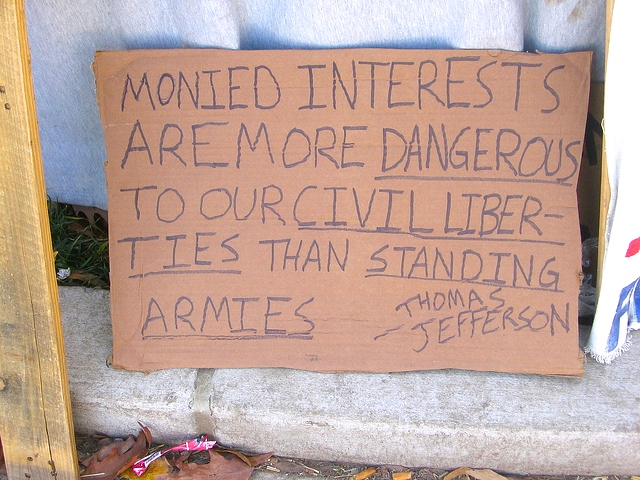
Instead, lawmakers respond to the policy demands of wealthy individuals and monied business interests – those with the most lobbying prowess and deepest pockets to bankroll campaigns.
Before you’re tempted to say “duh,” wait a moment. Gilens’ and Page’s data come from the period 1981 to 2002. This was before the Supreme Court opened the floodgates to big money in “Citizens United,” prior to SuperPACs, and before the Wall Street bailout.
So it’s likely to be even worse now.
But did the average citizen ever have much power? The eminent journalist and commentator Walter Lippman argued in his 1922 book “Public Opinion” that the broad public didn’t know or care about public policy. Its consent was “manufactured” by an elite that manipulated it. “It is no longer possible … to believe in the original dogma of democracy,” Lippman concluded.
Yet American democracy seemed robust compared to other nations that in the first half of the twentieth century succumbed to communism or totalitarianism.
Political scientists after World War II hypothesized that even though the voices of individual Americans counted for little, most people belonged to a variety of interest groups and membership organizations – clubs, associations, political parties, unions – to which politicians were responsive.
“Interest-group pluralism,” as it was called, thereby channeled the views of individual citizens, and made American democracy function.
What’s more, the political power of big corporations and Wall Street was offset by the power of labor unions, farm cooperatives, retailers, and smaller banks.
Economist John Kenneth Galbraith approvingly dubbed it “countervailing power.” These alternative power centers ensured that America’s vast middle and working classes received a significant share of the gains from economic growth.
Starting in 1980, something profoundly changed. It wasn’t just that big corporations and wealthy individuals became more politically potent, as Gilens and Page document. It was also that other interest groups began to wither.
Grass-roots membership organizations shrank because Americans had less time for them. As wages stagnated, most people had to devote more time to work in order to makes ends meet. That included the time of wives and mothers who began streaming into the paid workforce to prop up family incomes.
At the same time, union membership plunged because corporations began sending jobs abroad and fighting attempts to unionize. (Ronald Reagan helped legitimized these moves when he fired striking air traffic controllers.)
Other centers of countervailing power – retailers, farm cooperatives, and local and regional banks – also lost ground to national discount chains, big agribusiness, and Wall Street. Deregulation sealed their fates.
Meanwhile, political parties stopped representing the views of most constituents. As the costs of campaigns escalated, parties morphed from state and local membership organizations into national fund-raising machines.
We entered a vicious cycle in which political power became more concentrated in monied interests that used the power to their advantage – getting tax cuts, expanding tax loopholes, benefiting from corporate welfare and free-trade agreements, slicing safety nets, enacting anti-union legislation, and reducing public investments.
These moves further concentrated economic gains at the top, while leaving out most of the rest of America. No wonder Americans feel powerless. No surprise we’re sick of politics, and many of us aren’t even voting.
But if we give up on politics, we’re done for. Powerlessness is a self-fulfilling prophesy.
The only way back toward a democracy and economy that work for the majority is for most of us to get politically active once again, becoming organized and mobilized.
We have to establish a new countervailing power. The monied interests are doing what they do best – making money. The rest of us need to do what we can do best – use our voices, our vigor, and our votes.
3 WAYS TO SHOW YOUR SUPPORT



- Log in to post comments


