
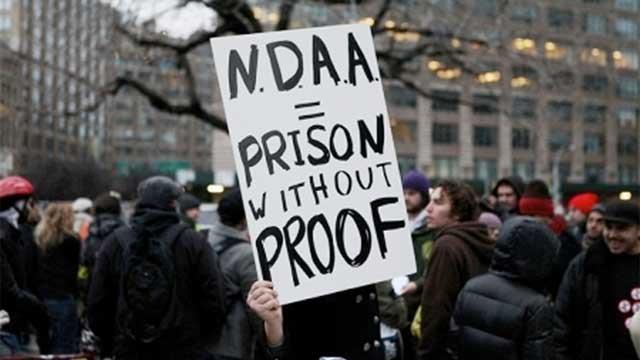
Last Tuesday, the Senate passed the National Defense Authorization Act, or NDAA, a yearly military spending bill.
Last year, the bill affirmed the U.S.'s authority to hold suspected terrorists indefinitely and without charges. The provision had generated plenty of controversy, particularly about whether U.S. citizens could be detained indefinitely. This year, the Senate bill says that citizens can't be detained in the U.S. - but concerns remain about the scope of detention powers.
We've taken a step back, run through the controversy, and laid out what's new.
What does the law currently say about military detention?
Section 1021 of last year's National Defense Authorization Act affirms the military's ability under the law of war to detain people "without trial until the end of hostilities."
It also holds they can be tried at a military commission, transferred to another country or to "an alternative court" - leaving open the possibility of civilian trials.
Who can be detained?
Anyone who "planned, authorized, committed, or aided" the 9/11 attacks, or "harbored those responsible." Also, anyone who been "part of or substantially supported" Al Qaeda, the Taliban, "or associated forces that are engaged in hostilities against the U.S. and its coalition partners."
Does that include U.S. citizens?
Congress left that deliberately unspecified last year, essentially punting the issue to the courts.
The language in the bill didn't outright permit or prohibit indefinite detention of U.S. citizens. The act stated that it wouldn't affect "existing law or authorities relating to the detention of United States citizens, lawful resident aliens of the United States, or any other persons who are captured or arrested in the United States."
But existing laws and authorities don't actually give a definitive answer. There were cases involving U.S. citizens held by the military under President George W. Bush, but no precedents were established. The Supreme Court ruled only narrowly on the case of Yaser Hamdi, on the basis that he was captured on the battlefield in Afghanistan. (Hamdi was released and went to Saudi Arabia in 2004.)In a second case, Jose Padilla was transferred to a civilian court.
In signing the bill last year, Obama said that his administration "will not authorize the indefinite military detention without trial of American citizens." Critics were quick to point out that this was a non-binding policy, and that the law left the door open for future administrations to interpret it differently.
But this year's bill fixed all this confusion, right?
Kind of.
In a replay of last year's debate, a flurry of proposed amendments went around the Senate in an attempt to clarify the language about indefinite detention. Ultimately, the Senate passed an amendment from Senator Dianne Feinstein that seems to protect U.S. citizens:
"An authorization to use military force, a declaration of war, or any similar authority shall not authorize the detention without charge or trial of a citizen or lawful permanent resident of the United States apprehended in the United States, unless an Act of Congress expressly authorizes such detention."
What about people detained in the U.S. who aren't citizens or permanent residents?
They could still be indefinitely detained.
Human rights and civil libertarian groups criticized the amendment for falling short of the protections in the constitution under the Fifth Amendment, which says that any "person" in the U.S. be afforded due process.
In the floor debate, Feinstein said she agreed with critics that allowing anybody in the U.S. to be detained indefinitely without charges "violates fundamental American rights." Feinstein said she didn't think she had the necessary votes to pass a due-process guarantee for all.
So does that settle it? Citizens can't be detained?
Depends which senator you ask.
Some voted for Feinstein's amendment even though they think the military should be able to indefinitely detain people within the U.S. They think her amendment still allows it, because of the last clause - "unless an Act of Congress expressly authorizes such a detention."
As the Hill reported, Senators Lindsey Graham, John McCain and Carl Levin all claim that Congress' 2001 Authorization for Use of Military Force, or AUMF, does authorize the detention of citizens, even in the U.S. They cited the Hamdi case, despite the fact that he was captured abroad.
What about last year's NDAA? Isn't that an Act of Congress authorizing detention?
Not expressly. It gets back to that non-position that last year's bill settled on - "Nothing in this section shall be construed to affect existing law or authorities" about the detention of U.S. citizens.
Does the NDAA go farther than the post-9/11 AUMF?
On the surface, yes, but many courts have already used AUMF to affirm broad presidential powers.
The AUMF doesn't mention detention, or Al Qaeda, the Taliban and associated forces, which the NDAA claims the U.S. has the authority to detain. It authorizes "necessary and appropriate force" against anyone involved with or harboring anyone involved with the 9/11 attacks.
But both Bush and Obama have maintained in court that the AUMF does authorize detention, and that its authorization applies to Al Qaeda, the Taliban, and "associated forces."
So the detention section of the NDAA largely echoes the authorities that Bush and Obama have previously asserted and gotten through the courts.
What the NDAA does do is "put Congress's stamp of approval" on these claims, which could have implications for future litigation. The Congressional Research Service report goes into more detail on the way that courts have interpreted "associated forces" and "substantial support" - phrases the NDAA doesn't attempt to define.
Isn't there a lawsuit going on over the NDAA?
Yes. Last year, a coalition of journalists and activists sued to block the indefinite detention provision on constitutional grounds. A U.S. District Court judge ruled in their favor in September, claiming that the government had overstepped in its interpretation of the AUMF. Her decision was stayed by an appeals court, who found it overly broad. The case is ongoing.
So what happens next?
The bill still has to be reconciled with the House version, which did not include an amendment to the detention provision like Feinstein's.
Obama has threatened to veto the NDAA over other measures, including restrictions on transfers from Guantanamo prison. But he said the same thing last year, and ended up signing the bill into law.
3 WAYS TO SHOW YOUR SUPPORT



- Log in to post comments


