
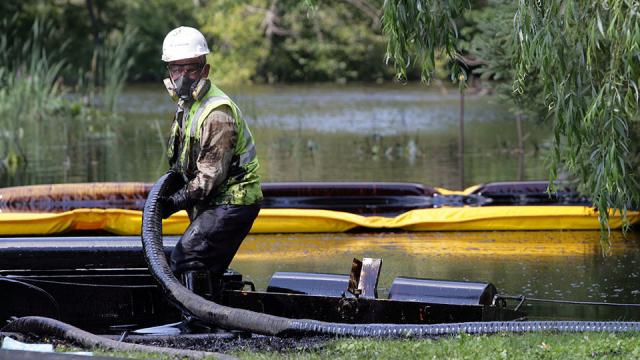
Three years ago, a six-foot crack in the wall of an Enbridge company pipeline ejected well nigh a million gallons of crude oil into a tributary of the Kalamazoo River, resulting in the largest and most costly inland oil spill in U.S. history. Much of that oil remains uncollected. Of this remnant, most cannot be actively removed from the river without causing catastrophic damage to the local ecosystem. If, by providence, it washes into a strategically placed petroleum trap, it will be collected. If not, it will not.
The particular variety of crude in question is known as “dilbit,” which is short for “diluted bitumen.” Bitumen is the kind of petroleum you get by dredging tar sands, and is precisely as nasty as the description makes it. “Asphalt” is another of its names. Companies that undertake the task of transporting bitumen to refineries are faced with a number of logistical difficulties.
Asphalt, as you might imagine, is not the kind of thing which lends itself well to pumping, since it is heavy and extremely viscous. There are various potential solutions to this problem, but dilution is, by a large margin, the most cost-effective. It’s even a bit elegant. Bitumen is mixed with something light and volatile like condensed natural gas. The mixture is sufficiently fluid to pipe in the traditional way, and is easily separated into its constituent parts during the refinement process. The bitumen can then be refined, and the diluent piped back for reuse. There’s a catch, though. A big, ugly, poisonous catch.
When dilbit finds its way into a body of water, the first thing it does is float. Conventional crude spills do this too, and floating oil is a nasty problem. Dilbit is worse. Once it’s out of the pipe, it functions kind of like an ecological bunker-buster bomb. Dilbit floats because it contains light, volatile diluents. Once the volatile diluents evaporate (which they do, quickly) the bitumen doesn’t float anymore. It sinks. At the bottom of the water column it comes to rest in sediment, and it sticks. It sticks so well, in fact, that the only feasible way of recovering it involves churning up and processing sediment, which is costly and extremely disruptive to local ecosystems.
The bitumen which is sitting in the bed of Kalamazoo River originated in the vast Athabasca oil sands of Eastern Alberta. In June of 2010, a stretch of pipe on Enbridge’s Line 6B suffered a corrosion-related failure and began dumping crude into Talmadge Creek, which carried it into the river. Alarms were triggered. The initial response by Enbridge staff -- due to a peculiar lapse in judgment which the National Transportation Safety Board construed as either “misunderstanding” or “disbelief” at the aforementioned alarms -- was to continue to pump dilbit through the pipe for 17 hours.
When officials finally realized what was going on, huge volumes (estimates hover just under 900,000 gallons) of dilbit had been released into the waterways. Several dozen households were prompted to evacuate, and many more were informed that their drinking water was no longer safe.

The subsequent scramble to correct all this was less than optimally managed. The EPA initially projected a cleanup timeline of a few months, with an estimated price tag of $5 million. But a bitumen spill, as we now know, is not an easy thing to tidy. Two years following the pipeline rupture, cleanup continued. $756 million dollars had been spent. The EPA estimates that there are still about 180,000 (plus or minus 100,000) gallons of crude still lining the Kalamazoo River. That’s a scary number, to be sure, but scarier still is the fact that while the EPA has ordered Enbridge to continue removing oil from the river, the company just can’t get it all.
The order specifies that, by December 31 of this year, Enbridge is to dredge the remaining “recoverable oil” from three key sections of the river. Recoverable oil, in this case, is oil which can be removed without “causing significant adverse impacts to the river,” and the EPA estimates its volume at between 12,000 and 18,000 gallons. The recovery of the remaining 100,000 or so gallons will depend on whether the oil drifts into areas where sediment traps have been stationed.
The human impact of the spill, and of the massive and ongoing cleanup and pipeline reconstruction efforts, are documented on the Line6B Citizen’s blog. The narrative that emerges from the recorded accounts is a familiar one. Citizens are outraged and disheartened by the conduct and continuing presence of Enbridge employees on their properties. Complaints regarding standing water are ignored or misunderstood. A man hunting on his own property is reported to local police by Enbridge employees as having shot at them. Large stands of beloved pines are torn down to expedite projects intended to protect uncontaminated water supplies, but the projects are never completed.
It is difficult to parse what these stories mean collectively with regard to the competency of the company’s efforts. The magnitude of the disruption these efforts represent, however, is unambiguously frightening. Marty Burke, the hunter, wrote an entry on September 9, three years after the initial Line 6B spill, that concludes: “It truly is numbing and it truly is a nightmare. How can it happen in America? Who would let such a thing happen to us? Who would put themselves in our shoes?”
The business of piping huge volumes of diluted bitumen has by no means abated, and spills continue to occur all over the place. A leak at an Alberta tar sands operation which began in May of this year is still hemorrhaging bitumen. A month later, a scientist at Canadian Natural Resources Ltd., the company responsible for the spill, described the general state of panic in his organization to the Toronto Star: “Everybody (at the company and in government) is freaking out about this. We don’t understand what happened. Nobody really understands how to stop it from leaking, or if they do they haven’t put the measures into place.”
Earlier this year, an Exxon Mobile pipeline emptied 84,000 gallons of dilbit into a rural Arkansas subdivision. A recent bitumen leak in North Dakota was detected by agricultural workers more than a week before any report surfaced from the company responsible for the accident. The list goes on. And the cleanup goes on. And on. And on.
Various proposed pipelines, including the Keystone XL and Kinder Morgan pipelines, if completed, will bring hundreds of thousands of additional barrels of diluted bitumen across the U.S./Canadian border each year. One wonders, with the first major bitumen pipeline spill not yet redressed, if we’re actually ready for that.
3 WAYS TO SHOW YOUR SUPPORT



- Log in to post comments


