
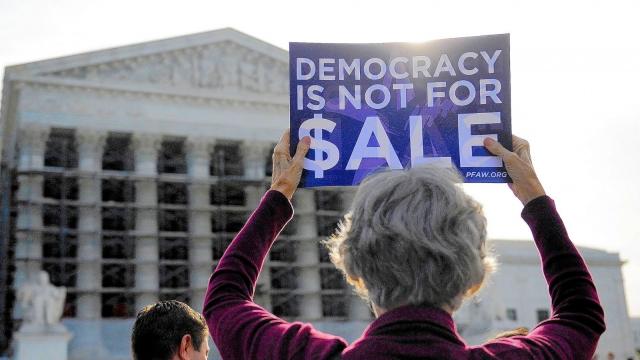
In a gesture probably more symbolic than practical, the Senate may soon take up a constitutional amendment to give Congress and states the power to regulate political contributions and spending.
At a Senate Rules Committee hearing last Wednesday on the influence of so-called "dark money" groups, nonprofits that don't have to report their donors for election spending, Sen. Chuck Schumer, a New York Democrat, said Democrats would soon bring the amendment up for a vote.
The amendment, introduced last year by Sen. Tom Udall, a New Mexico Democrat, would allow Congress to limit contributions and spending by campaigns, as well as by super PACs and dark money groups. States would be allowed to pass their own regulations.
The amendment could be the only way to reverse the impact of Supreme Court decisions that have struck down some limits on contributions by corporations, unions, nonprofits and individuals to both outside groups and, more recently, to political parties.
"It's now crystal clear to me that an amendment to the Constitution is necessary to allow meaningful campaign finance rules," Udall said on Wednesday.
The amendment has little chance of passing, however, as it needs the support of 67 senators. Republicans are unlikely to vote for it. Many conservatives see limits on campaign finance as limits on free speech. Conservatives also have benefitted more from the gusher of outside money so far.
Predictably, the hearing last week reinforced the sharp divisions between Republicans and Democrats on campaign finance.
Schumer, Udall and Sen. Amy Klobuchar of Minnesota, Democrats on the committee who were at the hearing, called for new campaign finance restrictions. And Sen. Angus King, the Maine independent who led the hearing and who often votes with Democrats, was particularly critical of dark money groups, the social welfare nonprofits and trade associations that can spend money on elections without disclosing their donors.
"In Maine, we have town meetings every spring," King said. "Nobody's allowed to go to a Maine town meeting with a bag over their head."
But Sen. Pat Roberts of Kansas, the ranking Republican on the committee, spoke out against new regulations as restrictions on free speech, pointing to a plaque he had brought displaying the text of the First Amendment.
"Let's stop this fool's errand of speech regulation," he said.
At issue isn't simply speech—it's whether who's behind that speech should be identified. Disclosure is something that many courts have said is paramount.
The Supreme Court's Citizens United ruling, for example, said that corporations, unions and nonprofits could spend unlimited money on outside election ads. Justice Anthony M. Kennedy said the influx of that money would not corrupt elections because of laws requiring outside groups to disclose their donors.
ProPublica and other news outlets have written extensively, however, about the many ways groups have used to avoid this kind of transparency. In 2012 alone, social welfare nonprofits and trade associations dumped more than $310 million into the election. Who are the donors? Who knows?
As the Center for Responsive Politics reported Wednesday, the 2014 election is so far shaping up to involve more dark money than any election to date. And Democrats are narrowing the gap with Republicans, who have typically spent much more through dark money groups.
Sen. Ted Cruz of Texas, the other Republican who attended the hearing Wednesday, addressed the disclosure issue, at least partly. He called for allowing unlimited contributions to candidates followed by immediate disclosure of who gave the money. But Cruz did not say whether he also supported such disclosures by dark money groups.
A slate of campaign finance experts testified before the committee, including former Supreme Court Justice John Paul Stevens, who wrote the dissenting opinion in the Citizens United case before his retirement in 2010 and recently authored a book proposing a constitutional amendment to limit political spending.
In an interview with ProPublica after the hearing, King said he imagined Democrats would try to bring Udall's amendment to the floor this summer but acknowledged that passing it would be difficult. He said he is more focused on passing legislation to require more campaign finance disclosure.
"I know there are Republicans who are interested in this issue and have expressed it," he said.
He declined, however, to name them.

3 WAYS TO SHOW YOUR SUPPORT



- Log in to post comments


