
On the afternoon of May 15, 2011, thousands of citizens suddenly began filling the streets and occupying the squares of more than 50 Spanish cities. Some of them camped out there for months. They had been summoned to a protest march by a group called Democracia Real Ya (Real Democracy Now) through the social networks.
With local and regional elections scheduled for May 22, very few media outlets saw the 15-M movement coming. And Spain’s political parties certainly did not.
Three years later, Podemos (We Can), a party that rose out of the ashes of that movement, became the fourth-most-voted political force in Spain at the European elections in late May. Nobody saw that coming, either.
Podemos was registered as a party just three months ago, following a heated debate among neighborhood assemblies – what was left of the 15-M movement – over whether work should continue at the grassroots level or whether it should be given a formal structure, its founders explain.
For now at least, the party has no leadership bodies and no membership cards. Yet it will have five seats in the European Parliament after receiving 1.2 million votes at last month’s poll.
As of several weeks ago, Podemos was still facing the new challenge of organizing itself and creating a leadership that will make day-to-day decisions and hold its five eurodeputies accountable. This is especially important because if May’s results are repeated in Spanish general elections in 2015, Podemos could hold the key to local and regional governments. And it will have to make decisions.
“We were practically born on the campaign trail. To this day, we are a campaign team rather than a party proper. Now we need to begin a constitutional process,” says Íñigo Errejón, 30, who has a PhD in political science from Madrid’s Complutense University and acts as campaign director for Podemos.
The goal, he says, is to combine the movement’s “open participation” system with the creation of “stable leadership structures.”
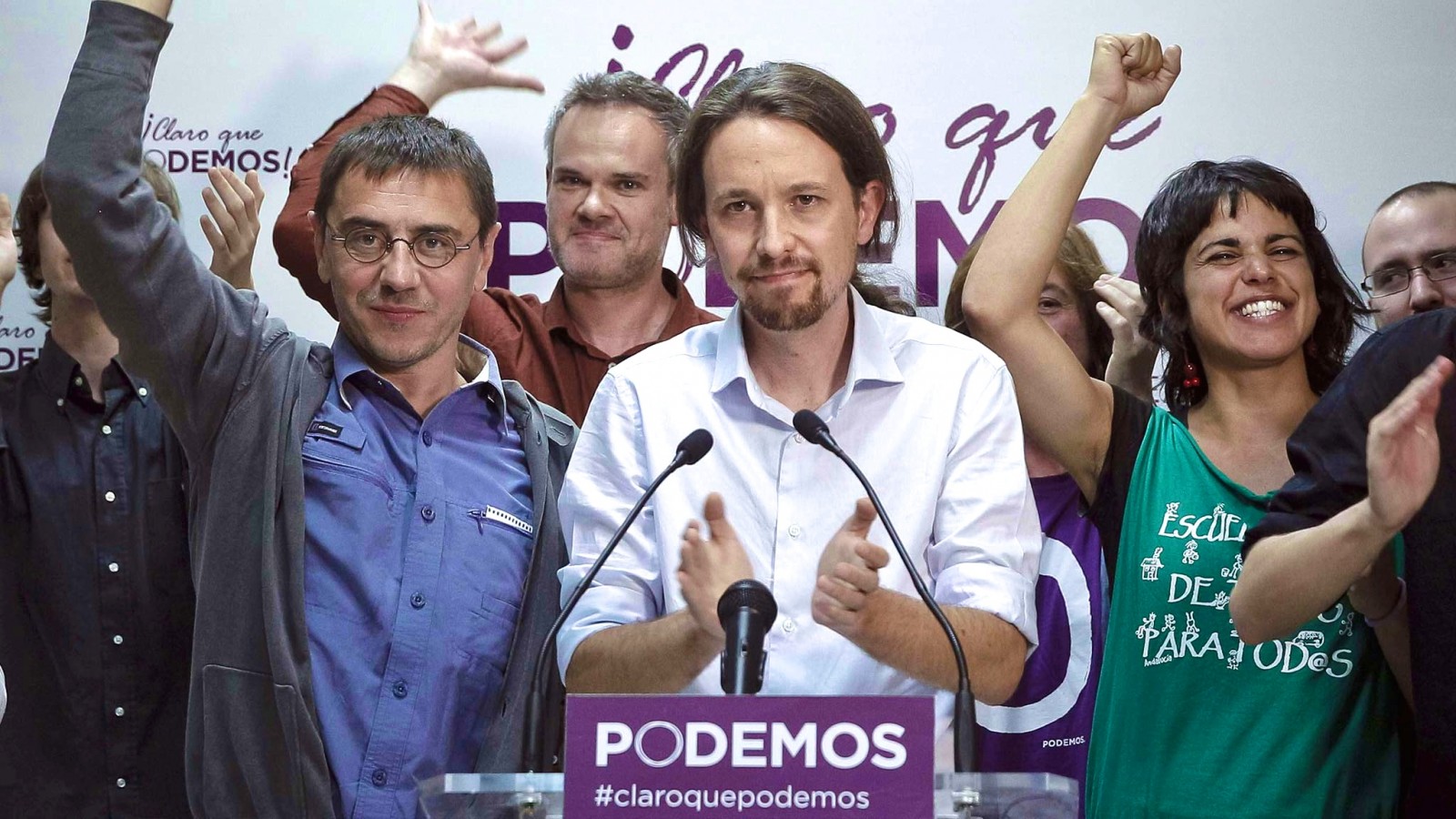
The community spirit that permeated 15-M – where for months decisions were only adopted after unanimous votes and there were no permanent spokespeople – has given way to a party that will start playing the political game and where one man, Pablo Iglesias, is the unquestionable leader. It was his face, familiar to television viewers through his frequent participation in debate programs, that dominated the campaign.
Until now, participation in the party has been channeled through the “circles,” around 300 working groups distributed across city neighborhoods, towns and villages. Thousands of people have used these “circles” to voice their ideas for a new party that aims to be different in every way.
These groups, which do not necessarily share an ideology, are united by the desire to “take back our kidnapped democracy,” says Errejón. “There are already lots of parties.”
Errejón says that the initial formula of direct participation can and must remain intact even now, yet even he admits that the link between representatives and their constituency will have to be articulated in a more traditional, stable way for the sake of efficiency. That will be the task ahead for the coming months.
Errejón experienced the precarious conditions of a university student in Spain and finally found a job in Quito (Ecuador) as a political science teacher. He says he has been with the Podemos project from the beginning.
“In Spain we saw that on the one hand, we had the political caste, and on the other, the citizens. Any political expression of discontent was very timid,” he explains. “The campaign had to support itself on common sense on the one hand and on the possibilities of change on the other. We designed an audacious campaign.”
They decided not to ask for loans from banks or construction companies “so we wouldn’t owe them anything.” They raised funds by asking for voluntary donations.
While Errejón once lived in Ecuador, one of the founders and ideologues behind Podemos, Juan Carlos Monedero, used to live in Venezuela. A 51-year-old lecturer of political theory at Madrid’s Complutense University, Monedero was another regular presence on a TV debate program called La Tuerka, aired by TeleK, a local network in the blue-collar Madrid neighborhood of Vallecas.
He owned the internet domain noalaguerra.org (notowar), was a card-carrying member of the United Left between 1986 and 2005, and for nine years worked as an advisor to former Venezuelan president Hugo Chávez, although at some point he came to question the regime’s “hyperleadership.”
Questions about this period of his life immediately put Monedero on the defensive: “Everybody asks me about Venezuela and not about my period in Germany, where I did my dissertation on the dissolution of the German Democratic Republic. Whoever says we want to turn Spain into Venezuela is an idiot.”
Instead, his vision for Podemos is the following: “We want it to be the key for building a broad front like the one they have in Uruguay; we want it to be a meeting point between parties and social movements that will let us reinvent democracy and create a constitutional process. That’s the way it was in Bolivia, Venezuela and Ecuador.”
3 WAYS TO SHOW YOUR SUPPORT



- Log in to post comments


