
“We are all here today to say one thing: that our democracy is not for sale,” said Sen. Amy Klobuchar, raising her voice into the mic as cheers rose from the crowd behind her and dark clouds hung low over the Capitol building.
Rain threatened but never came to the Senate Swamp, where activists congregated Monday afternoon to show support for the handful of lawmakers taking a stand against money in politics. The ominous weather made an apt scene to discuss dark money and corporate power, as speakers from both houses took turns at the podium next to a wall of boxes that held three million signatures in support of Senate Joint Resolution 19 (SJR19), popularly known as the Democracy for All Amendment.
Authored by Sen. Tom Udall, the resolution calls for a constitutional amendment to overturn Citizens United, the 2010 Supreme Court Decision that opened the floodgates for corporate spending to influence political elections.
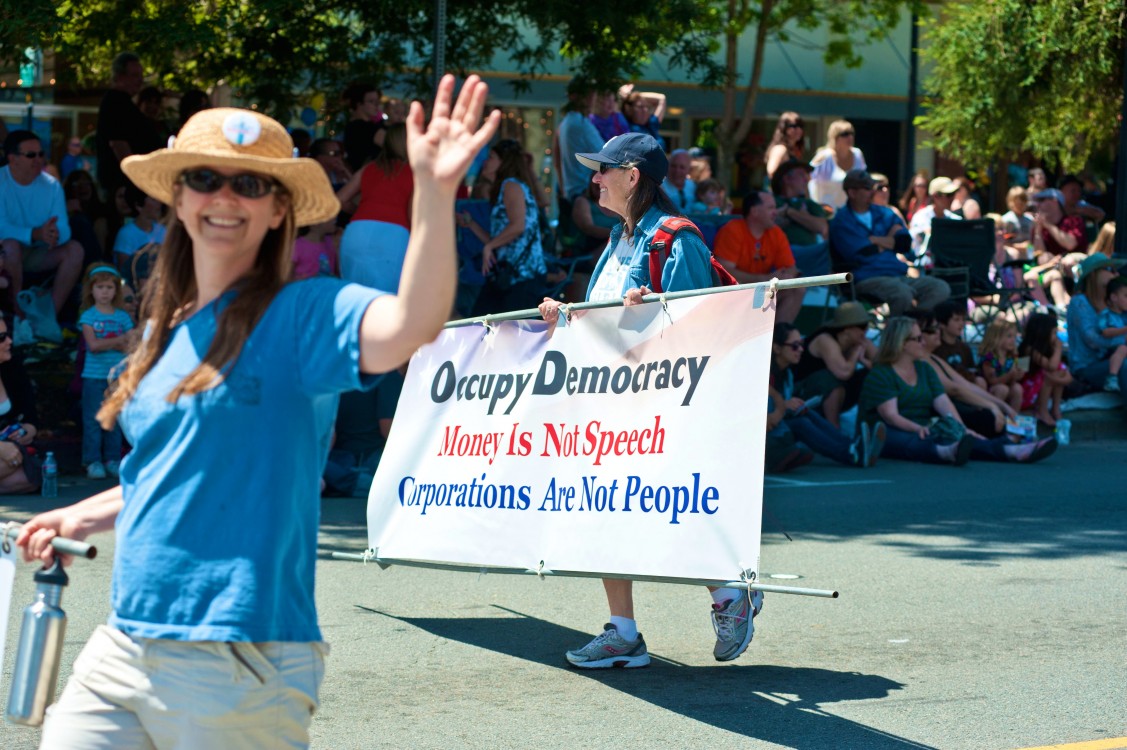
On top of allowing unlimited spending on ads and other influential campaign tactics, the Citizens United decision furthered corporate personhood by asserting that corporations' right to influence elections falls under their First Amendment right of free speech – suggesting that corporations are people and that their money is equal to speech.
In response, the Amendment known as SJR19 includes the following:
“Section 1. To advance democratic self-government and political equality, and to protect the integrity of government and the electoral process, Congress and the States may regulate and set reasonable limits on the raising and spending of money by candidates and others to influence elections.
"Section 2: Congress and the States shall have power to implement and enforce this article by appropriate legislation, and may distinguish between natural persons and corporations or other artificial entities created by law, including prohibiting such entities from spending money to influence elections.
"Section 3: Nothing in this article shall be construed to grant Congress or the States the power to abridge the freedom of the press.”
Although this language makes clear the difference between corporate money and free speech, many opponents, mostly from the GOP, have sought to tear the Amendment apart, claiming it will curb the average American's First Amendment rights.
Simply. Not. True.
All one has to do is read the language in the resolution to see that this is in fact the opposite goal of the bill and proposed amendment.
Corporate rights are not human rights, or at least they shouldn't be. This is a distinction that was destroyed by Citizens United – and which the lawmakers behind the current bill are trying to clearly, and markedly, draw once more. It seems they need reminding: We the people are we the people.
As Robert Weissman, president of Public Citizen – one of the four main organizations behind the grassroots work that went into SJR 19 – put it:
"It's common sense that we can't maintain a democracy if our politicians are indebted to a tiny class of political donors. And it's common sense that we will fail to solve the greatest challenges of our time – catastrophic climate change, rising inequality, health care for all and much more – unless we repair our campaign finance system and our democracy.”
Sen. Bernie Sanders echoed that sentiment at the podium.
“What you get as an average American at the ballot box is one vote. What the Koch brothers get is one vote plus the ability to spend hundreds of millions of dollars to elect candidates who represent the rich and the powerful,” Sanders said.
Later on Monday, the Senate voted 79-18 in what's called cloture, a Senate rule to avoid filibustering and endless delays, and to proceed with debate. Now, as the rules of cloture dictate, will follow 30 hours of debate, after which a senator will file cloture on the bill.
Once that is filed, whoever is managing the floor sets a final period of time for debate, and once that period of debate time passes, the Senate comes to a vote.
Translation: A final vote on resolution SJR19 will likely be heard by the end of this week. But terminology aside, is the prolonged debate good for those siding with the amendment?
“Absolutely,” says Angela Bradbery, director of publications at Public Citizen. “The debate provides an opportunity for more people in the country to contact their senators and urge them to back the amendment."
For example, "Activists will be doing events in several cities Wednesday," she said, "at the offices of GOP senators.”
Hoping to sway senators who are still on the fence, and to raise more awareness among the grassroots, Udall and his co-sponsors say they are determined and hopeful as they highlight the stakes in this week's Senate vote.
“The outcome of this debate will in fact determine whether or not we retain a middle class in this country, whether or not we retain a strong democracy in this country or whether we move toward an oligarchic form of society where the billionaire class not only controls the economy but controls the political life of this country,” Sanders said.
Part of that determination also means understanding that “this will be a long fight," said Sen. Al Franken, and that “it may not be this Congress” where the issue is resolved.
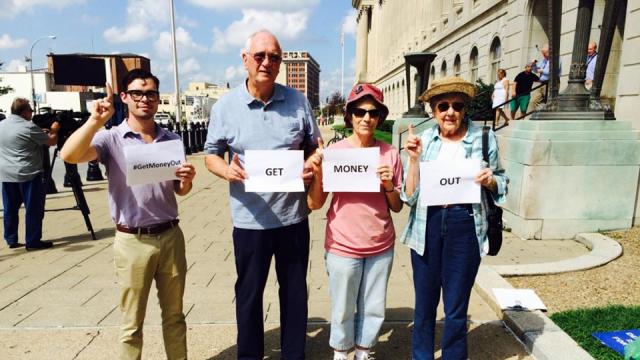
However, even with a potential defeat in the Senate, those present in the Capitol on Monday felt confident that Congress – and the corporate interests that influence their elections – could no longer ignore the groundswell movement nationwide to get money out of politics.
To inform yourself further and to get involved, visit Public Citizen, Common Cause, or People for the American Way. Many other organizations are working in coalition on grassroots initiatives as well.
For further articles about Monday's cloture vote and what we might expect to follow, see John Nichols's story onBillMoyers.com and Ramsey Cox's article in The Hill.
3 WAYS TO SHOW YOUR SUPPORT



- Log in to post comments


