
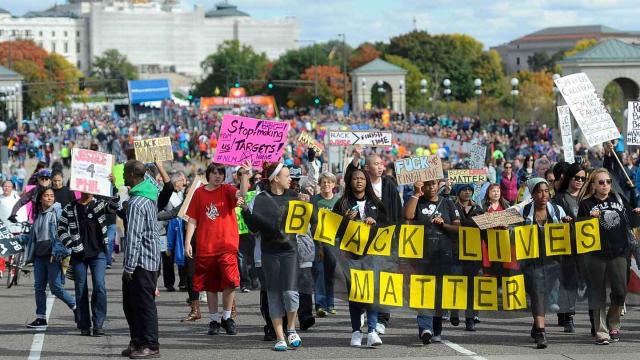
One commonly asked question about this moment in black-led organizing – what some broadly refer to as the Black Lives Matter movement – is what its participants want. What are BLM’s goals and why, some critics ask, is the movement so reactive, only vocal and visible in response to police violence against black people?
Starting this week, anyone with such questions can refer to A Vision for Black Lives, a document that lays out six demands and 40 corresponding policy recommendations to paint a picture of what today’s black activists are fighting for. At both the Democratic and Republican national conventions last month, there were plenty of indications that the current movement to end anti-black racism has made it to the national stage. The “Mothers of the Movement” – women whose children were killed by police or vigilantes or who died while in police custody – shared their stories at the DNC, making the case that their fights for justice would be in good hands with a Clinton presidency.
At the RNC, meanwhile, Milwaukee County’s Sheriff David Clarke, a black man, tried to calm the nerves of the largely white audience, assuring them that Donald Trump can restore law and order and put an end to the “anarchy” that BLM inspires.
The platform released on Monday emphasizes the movement’s independence from party politics and its desire to prioritize solutions that address root causes over the quick fixes more likely to win a presidential candidate’s support or move through an obstructionist Congress. For example, the nearly 40 policy recommendations include the following (quoting the group’s Aug. 1 press release):
"Demilitarize law enforcement, end money bail, end deportations, and end the systematic attack against Black youth, and Black trans, gender non-conforming and queer folks. Immediately pass state and federal legislation that requires the U.S. to acknowledge the lasting impacts of slavery, and establish and execute a plan to address those impacts."
"Democrats and Republicans are offering anemic solutions to the problems that our communities face,” said Marbre Stahly-Butts, a member of the eight-person Movement 4 Black Lives leadership team that steered the collaborative research and writing process over a year-long period. “We are seeking transformation, not just tweaks.”
Recommendations such as those above may strike some as too broad, too pie-in-the-sky. But the vision statement offers greater depth for readers who want to know how to translate the words into on-the-ground action. The section on demilitarization of law enforcement links to more information on bills in New Jersey and New Hampshire that could be used as model legislation for other states.
There’s advice on how to use federal law to demand that local elected officials reject military-grade equipment for police departments and that university presidents do the same with regard to campus police. What may seem at first glance like dreamy rhetoric that lacks the teeth to ensure real change is actually a toolkit for anyone ready to do the long-term work of running local or state-based advocacy campaigns.
Some such campaigns are active but unknown to people newer to organizing and activism. The collaborators behind this project want to change that by highlighting existing campaigns on the newly launched Movement 4 Black Lives website alongside the vision statement. More than two dozen black-led organizations, including Black Youth Project 100 (BYP100), the BlackOut Collective, the Center for Media Justice, the Million Hoodies Movement for Justice, and Southerners on New Ground, co-authored the vision statement through the year-long process, said Stahly-Butts, who is also a policy advocate at the Center for Popular Democracy.
“Those of us who have been inside this movement have seen there’s work happening across the country,” she said. Together they set out to answer the question: “How do we amplify what’s already happening?”
Authors of the Vision for Black Lives say policy is just one of many necessary tactics. Protest, direct action, advancing conversations that critique norms around race, gender, and sexuality are all part of the movement’s work as well, said Thenjiwe McHarris, another member of the eight-person leadership team that guided the process.
But articulating a set of demands then advocating for those demands to be met is critical too. Throughout their collaboration, the co-authors referred to earlier policy statements, such as the Black Radical Congress’s Freedom Agenda and the Black Panther Party’s 10-point platform in an effort to better understand similar black-led policy efforts that had come before.
“It builds on the legacy of the black radical tradition,” McHarris said of the document released Monday.
Originally published by The Nation
3 WAYS TO SHOW YOUR SUPPORT


- Log in to post comments


