
In an age of hidden election cash, the nation’s wealthiest public companies are increasingly revealing their campaign-related contributions and political policies — and doing so voluntarily.
More than three in four are more transparent than they were a year ago, with representatives of the pharmaceutical, IT service, chemical, health care and aerospace/defense industries ranking highest in a new study of political disclosure practices by the nonpartisan Center for Political Accountability and the Zicklin Center for Business Ethics Research at the University of Pennsylvania’s Wharton School.
The findings follow a 2012 election cycle in which nonprofit groups, fueled by corporate cash to a level unknown, spent more than $300 million to advocate for and against political candidates primarily through negative television advertising. Federal law doesn’t require such nonprofits to reveal their donors.
The study in part judges whether — and to what degree — companies publicly disclose donations to politically active trade groups and “social welfare” nonprofits, adopt policies that govern political expenditures and disclose payments made to influence the outcome of ballot measures.
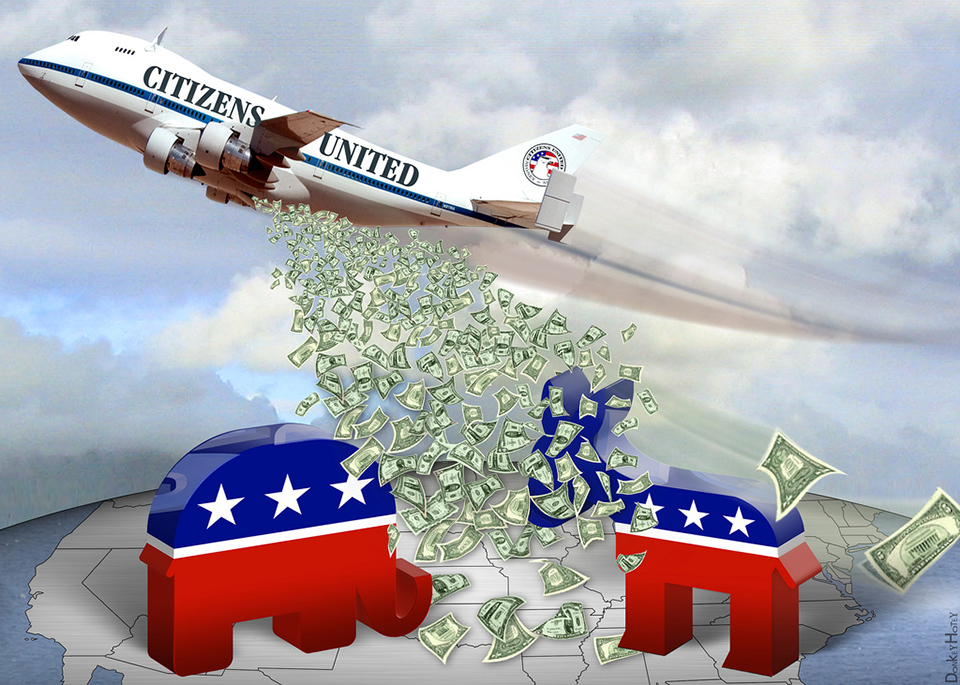
Improved disclosure hardly means all companies are willing to publicly out their politicking, which has become a major story line in federal politics since the Supreme Court’s Citizens United v. Federal Election Commission decision in 2010 granted corporations powerful spending freedoms.
To wit: a dozen of the 200 corporations studied didn’t snag a single point on the CPA-Zicklin index’s 70-point scale.
Financial service firms Charles Schwab Corp., T. Rowe Price Corp. and CME Group, as well as billionaire Warren Buffett’s holding company, Berkshire Hathaway, are among those earning goose eggs.
Internet giant Yahoo! Inc., Bank of America Corp., Wal-Mart Stores Inc., Priceline.com Inc., Amazon.com Inc. and CBS Corp. meanwhile dwell at the basement’s threshold, each collecting just a handful of points.
But drug maker Merck & Co. Inc., IT firm Qualcomm Incorporated and United Parcel Service Inc. are disclosure stars, according to the study, with each receiving 66 out of a possible 70 points.
Insurer AFLAC Inc., Microsoft Corp. oil company ConocoPhillips, communications company Time Warner Inc. and banks JPMorgan Chase & Co. and Wells Fargo & Co. also scored highly.
Slightly lower, but squarely in the index’s top quartile: tobacco makers Reynolds American Inc. and Altria Group Inc., aerospace and defense behemoth Boeing Co., retailer Costco Wholesale Corp., pharmaceutical firm Pfizer Inc. and computer chip manufacturer Intel Corp. Reynolds American corporate documents, for example, this year revealed that the firm recently helped bankroll prominent conservative nonprofits highly active during the 2012 elections.
Houston-based Noble Energy, which specializes in oil and gas production, recorded the greatest improvement from 2012 to 2013, as it jumped from barely above zero to just short of a perfect score. Railroad company CSX Corp. and Anadarko Petroleum Corp. also experienced dramatic jumps.
Half of the corporations studied publicly reveal at least some information about money they give to nonprofit trade associations organized under section 501(c)(6) of the Internal Revenue Service code.
About 37 percent of them either disclose information about some or all of their giving to 501(c)(4) nonprofit groups, or they simply don’t give to them at all. That’s notably up from last year, when one in four fit this description.
Corporations’ state-level ballot measure activity, meanwhile, is also growing more transparent, with nearly half disclosing some information. Last year, about 36 percent did.
Much of this increased disclosure can be attributed to shareholder pressure and greater public awareness about corporations funding politically active nonprofits, said Bruce Freed, president of the Center for Political Accountability.
“This has put the issue of disclosure squarely on the agendas of corporate boards,” Freed said. “The companies are taking this seriously.”
But while the study notes that many corporations have made “steady and tangible progress” in their political disclosure practices, it states that its findings also reflect “severe gaps that shroud many corporate spenders in secrecy in an era of surging hidden political spending.“
3 WAYS TO SHOW YOUR SUPPORT
- Log in to post comments


